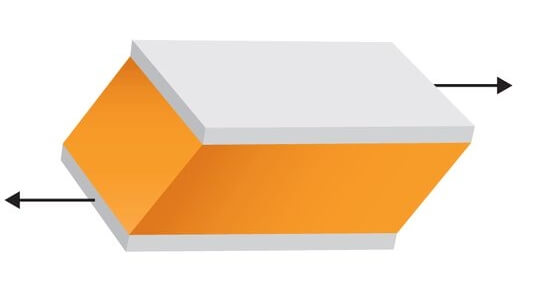
Intertronics academy: what is adhesive fixture time?
The fixture time for an adhesive (sometimes called the set time) is the shortest time required by the adhesive to develop handling strength such that substrates can be removed from fixtures, unclamped, or handled without stressing the bond – stress which might affect the ultimate bond strength. We can define handling strength as a (relatively) […]
Read More

UV Curing Guide offers top tips
The curing of materials like adhesives, coating, encapsulants, potting compounds, temporary masking materials or gaskets with UV light offers many process advantages, and can deliver productivity enhancements to manufacturers. The ability of the technology to deliver full cure in seconds (rather than minutes or hours) is a prime example. The materials are predominantly single part […]
Read More
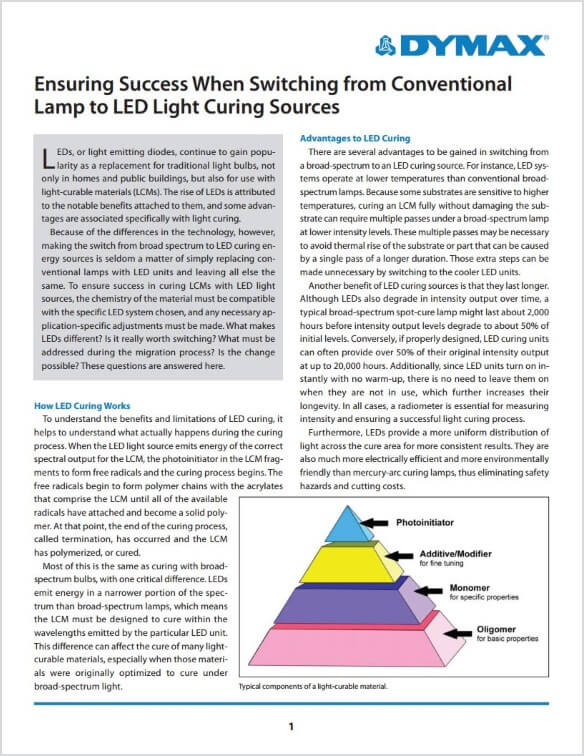
White Paper: Ensuring Success When Switching from Conventional Lamp to LED Light Curing Sources
The Dymax white paper Ensuring Success When Switching from Conventional Lamp to LED Light Curing Sources discusses topics such as how LED curing works, the advantages of LED curing, and getting enough information to switch successfully. LEDs, or light emitting diodes, continue to gain popularity as a replacement for traditional light bulbs, not only in homes […]
Read More
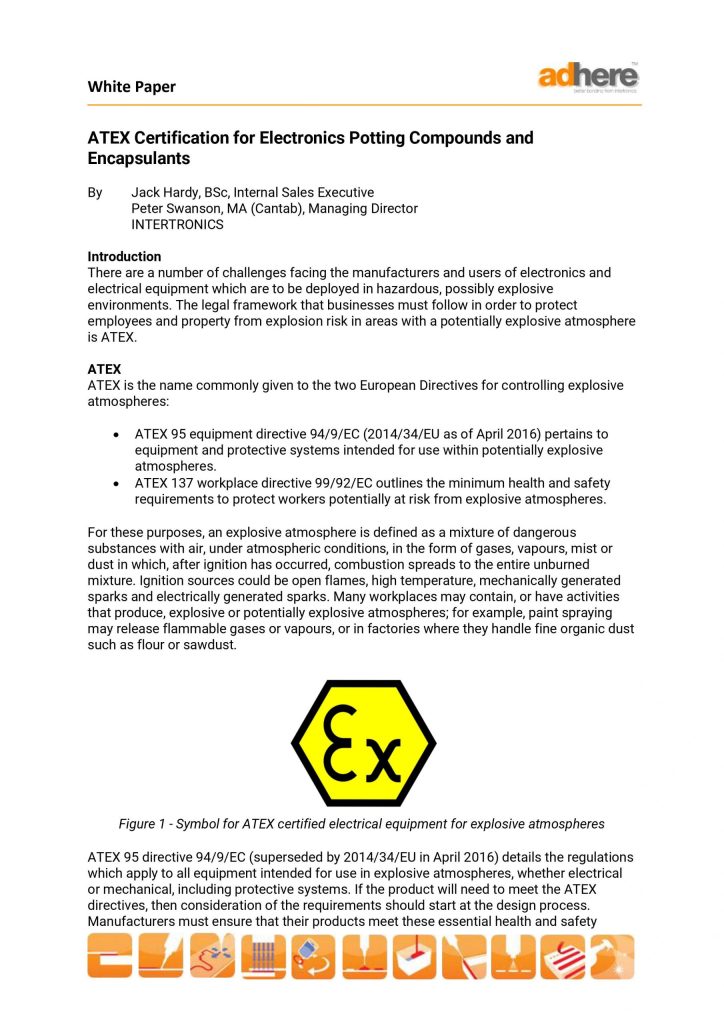
White Paper: Potting compounds for ATEX certification
Getting your product ATEX certified for use in explosive environments can be a challenging process. If your ATEX protection concept depends on a potting compound, then the certification body will have a number of technical and commercial demands of you, the material, and the material supplier/manufacturer. Our latest White Paper, ATEX Certification for Electronics Potting […]
Read More
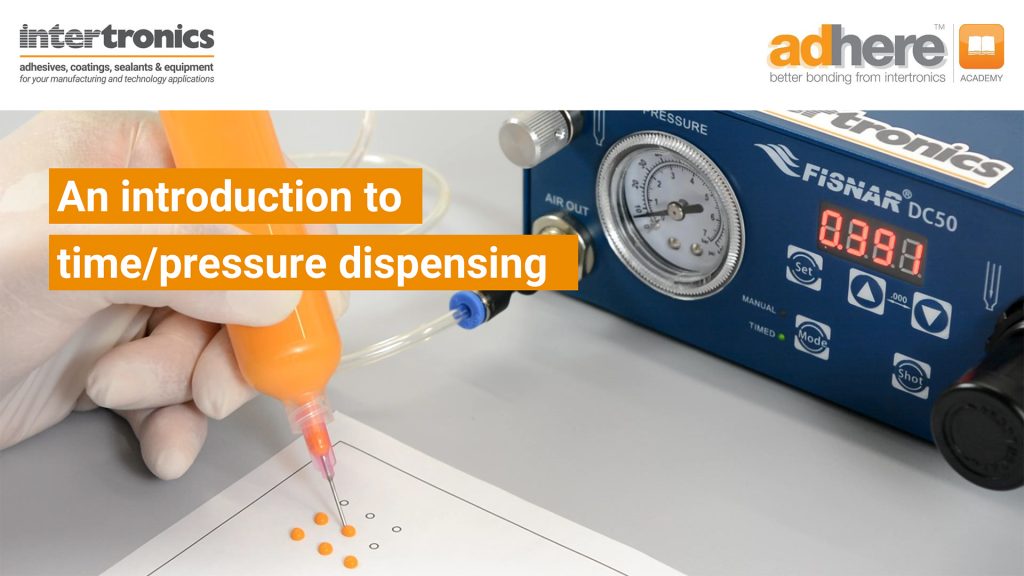
Introduction to time/pressure dispensing
If you ever thought about improving the manual application of your adhesives, oils, greases, solder pastes, sealants, inks or any other liquid or paste, then download a copy of our latest Technology Guide: An Introduction to Time/Pressure Dispensing. It talks about the advantages of this simple technology over brushing, daubing or squeeze bottles. The Guide […]
Read More
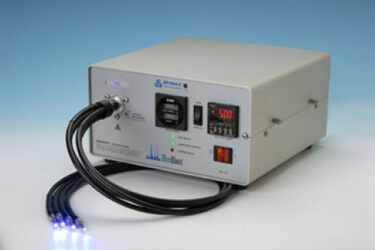
White Paper: Designing-in Light Curing Adhesives
Designing-in Light Curing Adhesives – this new authoritative white paper addresses the concepts around UV and visible light curing adhesives, starting with the design function. Design engineers will earn the gratitude of their production engineering colleagues if they can specify or allow for a light curing adhesive. In addition to performance advantages like distribution of load […]
Read More

Intertronics academy: epoxy crystallisation
The problem – Occasionally, we get a call from a customer saying that there is “something wrong” with the epoxy he bought from us. One of the constituents of the two part system (usually part “A”, the resin) has become cloudy, milky, has crystals in it, has become lumpy or slushy, or has even become solidified. The […]
Read More
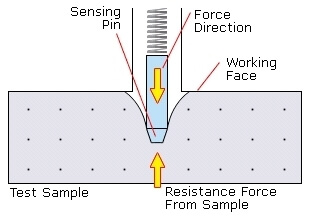
Intertronics academy: hardness
A recent Intertronics academy post discussed the modulus of elasticity of materials. Closely linked to that is another physical factor which we often quote on product data sheets: hardness. One way to define the hardness of a material is its resistance to permanent indentation. We all know that rubber balls are soft, and rock is hard, […]
Read More
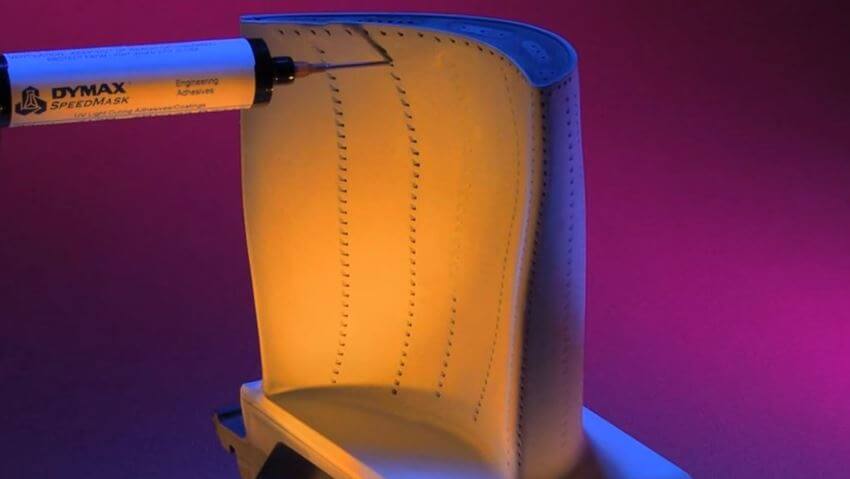
SpeedMask – UV curable masking resins reduce high value component processing costs
Losses from scrap in production of high value mechanical components is a vital consideration in improving quality and efficiency of manufacture; fortunately, we have available the DYMAX family of solvent free UV curable SpeedMask masking resins which offer significant improvements in reliability, worker safety, ease of use, quality of process outcome and actual piece part […]
Read More

Intertronics academy: modulus of elasticity
Many of our material product data sheets (PDS) will quote a number for the modulus of elasticity. The modulus of elasticity is a number which represents the material’s tendency to be deformed elastically (i.e. non-permanently, recovering original size and shape) when a force is applied to it. A stiffer material will have a higher modulus of elasticity, […]
Read More
Medical device bonding – adhesives for needles, cannula, catheters and guidewires
Two new selector guides are available, detailing our extensive range of DYMAX adhesives for bonding needles and catheters. The guides contain technical details about the wide range of adhesives available for these specific applications, as well as curing and dispensing information, and joint design advice. The selector guides are available from us in hard copy, […]
Read More

Electrically and thermally conductive adhesives – new products!
We are very pleased to announce that we have signed a distribution agreement with expert German adhesives manufacturer, Polytec PT. Polytec PT offers a range of high technology adhesive products for micro-electronics, hybrid circuits, chip-on-board (COB), LEDs, component manufacture, displays, flexible circuitry, shielding, medical devices and optics/opto-electronics. The range consists of: Electrically conductive adhesives Thermally […]
Read More
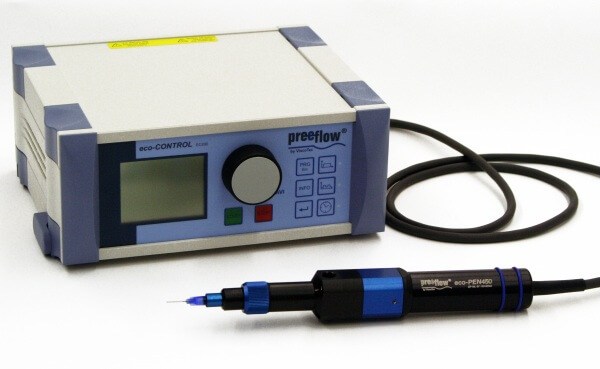
White Paper: Technology for Precision Dispensing
Just added to our webpage Technical Bulletins, White Papers & Articles – a new white paper entitled The “Endless Piston” Pump – Technology for Precision Dispensing. It discusses the technology behind our preeflow eco-PEN precision volumetric, positive displacement, dosing/dispensing systems. Why don’t you have a quick read?
Read More

UV light curing with LED lamps – unravelling the myths and realities
In recent years, there as been a great deal of interest in the use of LED technology for the curing of UV and visible light reactive adhesives and coatings. LED lamps can offer a number of benefits over the traditional and well understood mercury-based arc lamps, including significantly more stable output, instant on/off and no […]
Read More
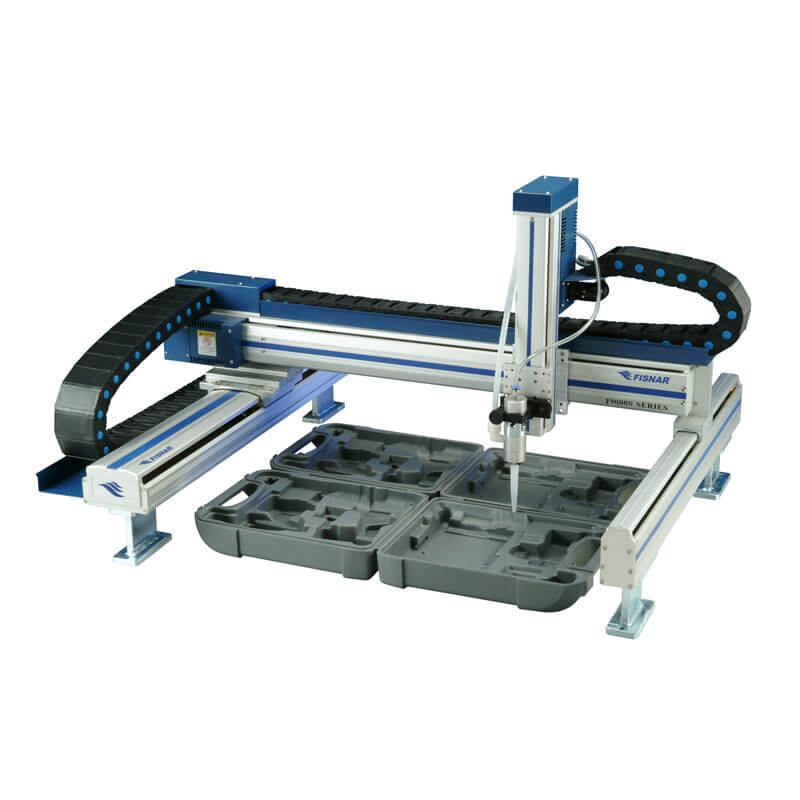
Small robots big on functionality…
… is the title of our article just published in the November/December 2010 issue of Industrial Plant & Equipment magazine. Read how benchtop robots achieve a high level of functionality, are readily available, simple to implement and inexpensive.
Read More