Drones are in high demand for consumer, commercial, and military use. Considerably cheaper to purchase and maintain than traditional aircraft, they are a cost-effective and efficient way to reach areas that may be difficult, dangerous, or inaccessible for traditional aircraft or ground-based monitoring systems.
That means they are being used for surveying agricultural crop health, fire fighting, delivering medical supplies, coordinating disaster response, inspecting industrial infrastructure, and constructing buildings.
Among festival crowds, you can watch multitudes of drones paint beautiful sky displays instead of firework shows. Or you might be clutching your drink harder in the cinema as you follow near-impossible cinematography through buildings and forests.
And in combat zones, drones and uncrewed aerial vehicles (UAVs) are changing the balance of power with real-time reconnaissance, attack, and defence.
A materials, design, and manufacturing challenge
The sheer speed of innovation in drone technology, with hugely compressed development cycles from lab to deployment, means that commercial and strategic advantage relies not just on technology. It relies too on your ability as a design and production engineer to be able to innovate and test quickly and then manufacture at scale.
Concepts pioneered in one type of aircraft are quickly adopted across the board into multirotor drones, fixed wing UAVs, and other small rotorcraft. At the same time, next generation air vehicles continue to push the limits of technology to satisfy demand for EVTOL aircraft, urban air mobility (UAM) passenger vehicles, cargo drones and heavy lift platforms.
Smart choices in aeronautics design and materials choice combined with the right bonding, sealing, and electronics protection will help you towards long-term success for airworthiness, manufacturability, and long‑term reliability.
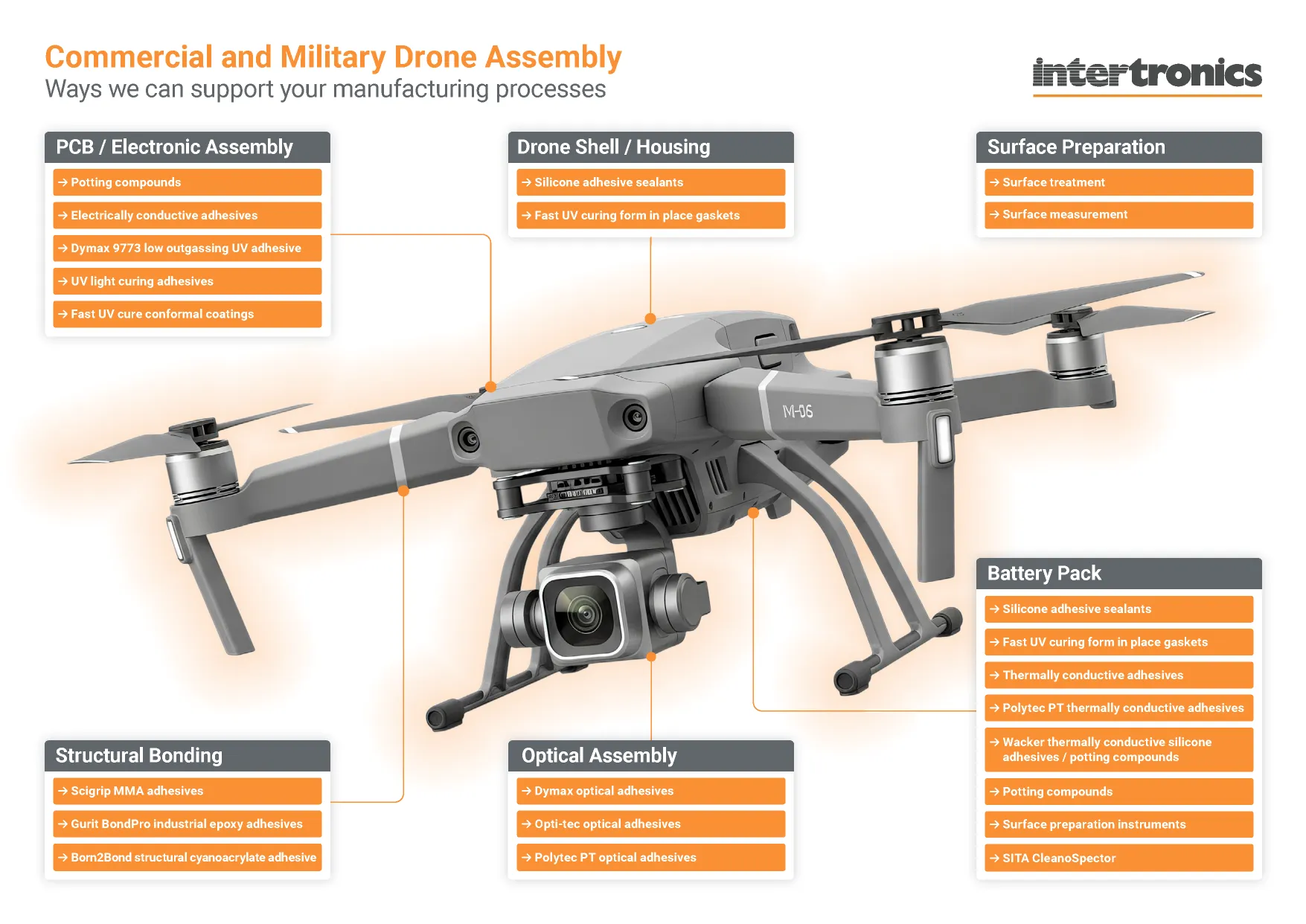
Commercial and military drone assembly: Ways we can support your manufacturing processes
Whether it’s staking components to survive vibration or using high‑performance structural adhesives to bond lightweight composites, Intertronics is here to help you.
With our experience of thousands of applications, we have a wealth of adhesives, dispensing, and curing technology knowledge to share. The Technology Centre at our Kidlington, Oxfordshire head office is custom-designed for hands-on demonstrations and trials of our ranges of materials, dispensing, curing and other equipment.
We offer a wide range of seminars targeted and tailored to your engineering teams, which can help you, and us, to fully understand the underlying technology of your materials, the challenges involved in the application of adhesives and protective materials, and the demands on production speed, tolerances, and repeatability required for QA specification and acceptance.
We are JOSCAR accredited, ISO 9001:2015 certified, and Cyber Essentials certified.

Structural bonding
Drone shell / housing
Surface preparation
PCB / Electrical Assembly
How can adhesives and protective materials solve key challenges for drones and UAVs?
| Problem Area | Challenge | Adhesive / Protective Material Benefit |
| Structural assembly | Weight reduction, aerodynamics | Structural adhesives reduce weight, streamline profiles, and bond composites, metals, plastics. Gaskets and sealants keep out air, dust, dirt. |
| Battery and power systems | Heat management, shock, vibration protection | Thermally conducting adhesives, gap fillers, and sealants manage heat flow and prevent fluid ingress |
| Electronics and avionics | Moisture ingress | Conformal coatings, encapsulants, and EMI shielding materials protect sensitive electronics |
| Optical and sensing modules | Precision alignment | Low shrink optical adhesives maintain alignment in camera, LIDAR, and sensor modules |
| Connectors and cabling | Shock, vibration, environmental ingress | Potting/staking adhesives reinforce components and give strain relief. Electrically conductive adhesives can reduce soldering |
Strong, lightweight adhesives for structural assembly
UAVs require extremely lightweight but strong structures to maximise range and payload, while at the same time withstanding vibration, thermal cycling, humidity and UV exposure.
Structural adhesives are an excellent choice for lightweight structural design and material integration. Replacing mechanical fasteners with adhesives reduces weight and gives better stress distribution, while maintaining airframe stiffness for aerodynamic stability.
Our ranges of MMA, CA, and epoxy adhesivesfrom Scigrip, Guritand Born2Bond allow you to bond together composites, plastics, glass and metals to withstand fatigue, impact shock, and dynamic loading throughout your product’s lifetime.
Silicone adhesive sealants from Wacker and fast UV curing form-in-place gaskets from Dymax can be used for sound and vibration dampening or for sealing to keep out air, dust, liquids, and dirt.
Vibration and environment protection
for electronics, avionics, PCBs
Electrical interconnects in drones experience high vibration loads, frequent shock events through take-off, landing, wind buffeting, or being struck by debris. This increases the risk of solder fractures, connector failures, sensor drift and electrical noise.
Our potting and staking adhesives can ruggedise components and reduce vibration-induced failures by increasing the mechanical stability and shock resistance of large or heavy components. We offer ranges from Adhere, Wacker, and Dymax.
For example, Dymax 9773 is a UV-curable staking/ruggedising adhesive for PCBs and board-level electronics compliant with Mil-Std-883 Method 5011. Certified to NASA ASTM E595 Low Outgassing, it meets Mil-Std 883 Method 5011 Low Ionic Content standards to help minimise PCB contamination and improve reliability in harsh environments.
Conformal coatings applied to electronic circuitry protects against moisture, dust, chemicals and temperature extremes to prevent complete failure of the electronic system. Dymax UV cure conformal coatings cure tack-free in seconds upon exposure to UV/visible light to help streamline manufacturing assembly processes.
Electrically conductive adhesives from Polytec PT are designed for electronic interconnects in a wide range of applications, including hybrid electronic assembly and solder replacement.
Thermally conductive adhesives from Wacker, Adhere and Polytec PT are ideal for heat management through a strong, durable bond and are a lightweight alternative to conventional jointing processes such as soldering, welding or screwing.
Optically clear, low stress joints for optics and sensing modules
Our range of optical bonding and positioning adhesives from Opti-tec, Polytec PT and Dymax have high clarity and excellent optical transmission. They are designed for lens assembly, optoelectronics, and fibre optic applications and deliver fast, reliable bonding with low movement and shrinkage.
These adhesives cure rapidly to form optically clear, low stress joints with high tensile strength and low shrinkage. They can bond glass, quartz, ceramics, metals, and plastics with minimal movement during cure.
 01865 842842 01865 842842 |  orders@intertronics.co.uk orders@intertronics.co.uk |